How to Optimize Your Product Pages for AI Visibility
In This Article
- The Technical Problem Most Ecommerce Teams Have Not Diagnosed
- Six Product Page Elements That Drive AI Visibility
- 1. Product Descriptions Built Around Use Cases, Not Features
- 2. Real-Time Pricing and Inventory Signals
- 3. Reviews That Reveal Patterns, Not Just Ratings
- 4. Awards, Certifications, and Third-Party Validation
- 5. Structured Data That Matches Every Visible Element
- 6. Crawl Budget Precision: Ensuring Your Best Pages Are Seen First
- What AI Looks for by Ecommerce Category
- The Brands That Act Now Will Own the Visibility Others Are About to Lose
Consumers are increasingly beginning their product journeys not with a keyword typed into Google, but with a conversational question fired at ChatGPT, Google's AI Mode, or Perplexity. Research indicates that well over half of shoppers now turn to generative AI tools at some point in the purchase process and that number is accelerating.
For marketers of leading ecommerce brands, this is not a future-state problem. AI-powered discovery is already reshaping which products get seen, considered, and bought. The brands winning in this environment share one common thread: their product pages are built for machines as much as they are for people.
This guide breaks down exactly how AI systems evaluate product pages, what signals drive recommendations, and the infrastructure changes that separate brands gaining visibility from those silently losing it.
How AI Systems Actually Evaluate Product Pages
Unlike a traditional search engine like Google that ranks pages based on link authority and keyword density, AI systems like ChatGPT, Claude, Google AI Overviews and Perplexity, evaluate product pages through two primary lenses: consistency and consensus.
Consistency means that the information AI finds about your product - price, availability, specifications, use cases, matches across your website, your product feeds, and third-party sources. When signals conflict, AI systems treat your content as unreliable and move on to a competitor they can cite with confidence.
Consensus means that multiple independent sources validate what your product is, what it does, and who it is best for. This includes customer reviews on your own site, editorial coverage, ratings on retail platforms, and third-party test results. The more aligned these external signals are, the more confidently an AI will recommend you.
These two filters explain something ecommerce marketers often find puzzling: why a technically inferior competitor with less traffic sometimes surfaces in AI responses ahead of a dominant brand. The answer is usually that their product information is cleaner, more consistent, and better validated across the web.
The Technical Problem Most Ecommerce Teams Have Not Diagnosed
Before any of the content-level optimization matters, your pages need to actually be readable by the systems doing the evaluating. And for many ecommerce sites, they are not, at least not fully.
AI crawlers, including GPTBot, do not execute JavaScript. They retrieve raw HTML and process whatever is present at that moment. For sites built on client-side rendering frameworks, where product titles, prices, and availability are assembled in the browser after a JavaScript event, the AI receives an empty shell. Your product does not exist in the response it reads.
According to Semrush's analysis, JavaScript-heavy pages take up to nine times longer to crawl than static HTML equivalents. Multiply that across a catalog of tens of thousands of SKUs and the compounding effect on crawl budget is enormous. Googlebot and GPTBot are both spending their limited attention on the scaffolding of your site rather than the products inside it.
Between May 2024 and May 2025, AI crawler traffic across the web grew by 96%. GPTBot alone went from 5% of AI crawler share to 30%. These systems are actively indexing ecommerce at scale, but only what they can read.
Six Product Page Elements That Drive AI Visibility
Assuming your pages are technically accessible, these are the content and structural elements that determine whether AI recommends your products or ignores them.
1. Product Descriptions Built Around Use Cases, Not Features
AI search is fundamentally intent-driven. When a shopper asks ChatGPT for cool Harry Potter themed shirts online, the system is not scanning for the phrase “shirts”. It is semantically matching your product copy to every element of that query - activity, conditions, and outcome.

Product descriptions that lead with what a product is used for and who uses it, consistently outperform descriptions that lead with technical specifications. The goal is to embed your product clearly within the situations where it becomes the answer. A single, well-defined use case on a PDP does more for AI visibility than a generic list of features that applies to every product in the category.

Practical approach: map your top-selling products to the most common customer scenarios that triggered their purchase. Interview recent buyers. Mine review data. What specific problem were they solving, and how do they describe it? That language belongs in your product copy.
2. Real-Time Pricing and Inventory Signals
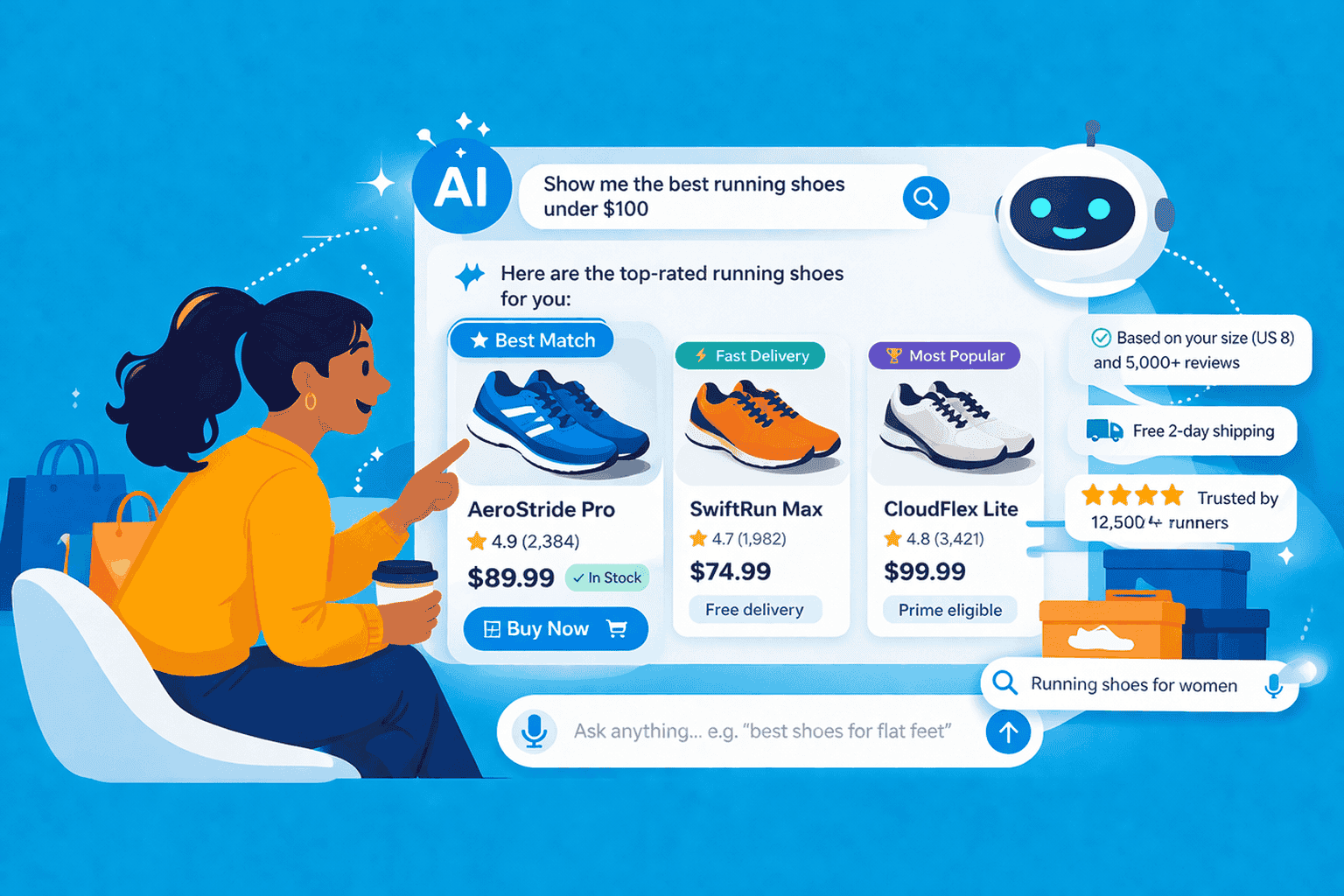
AI shopping assistants in ChatGPT, Google AI Mode, and Perplexity are now filtering product recommendations by price range, availability, and discount status in real time. If your data is stale or if your page price and your merchant feed price do not agree you fall out of those filtered results entirely.

The brands that surface consistently in AI price-filtered queries are those with live product feed connections to Google Merchant Center and, where applicable, first-party data partnerships with AI platforms directly. Sale pricing deserves particular attention: AI systems actively identify and surface discounted products when budgets are part of the query, but only when the original and sale price are both clearly presented and consistent across page and feed.
Treating your product feed as a core SEO asset, not just an advertising operations task, is one of the highest-ROI shifts an Ecommerce marketer can drive in 2026.
3. Reviews That Reveal Patterns, Not Just Ratings
AI systems do not just display star ratings - they analyze review content to understand what a product actually does in real-world use. Repeated mentions of specific use cases, materials, or benefits across a review set create a signal the AI can synthesize and restate in its recommendations.

A product with 4.7 stars and 600 reviews mentioning 'sensitive skin' will surface for sensitive skin queries even if the product description itself does not emphasize it. The crowd-sourced use case data functions as additional training signal for the AI. This is why actively managing the quality and specificity of your review program, not just the volume, is a strategic priority.
Prompt customers for situational context in review forms. Ask what they were trying to solve, not just whether they liked the product. That specificity is what AI reads and reuses.
4. Awards, Certifications, and Third-Party Validation
AI systems are designed to minimize the risk of recommending something that turns out to be wrong. Third-party validation like industry awards, safety certifications, editorial recognition, clinical test results, gives AI the external consensus signals it needs to cite your product with confidence.
Analysis of ecommerce brands tracked against AI visibility benchmarks shows a strong correlation: brands with above-average AI visibility rates consistently feature third-party recognition prominently on their product pages. Certifications function as trust anchors that both AI systems and consumers respond to.

If your brand has earned recognition - best-in-class awards, safety certifications, sustainability badges, media endorsements - these should be featured on the PDP itself, not buried in a brand story page that AI may never connect to the individual product.
5. Structured Data That Matches Every Visible Element
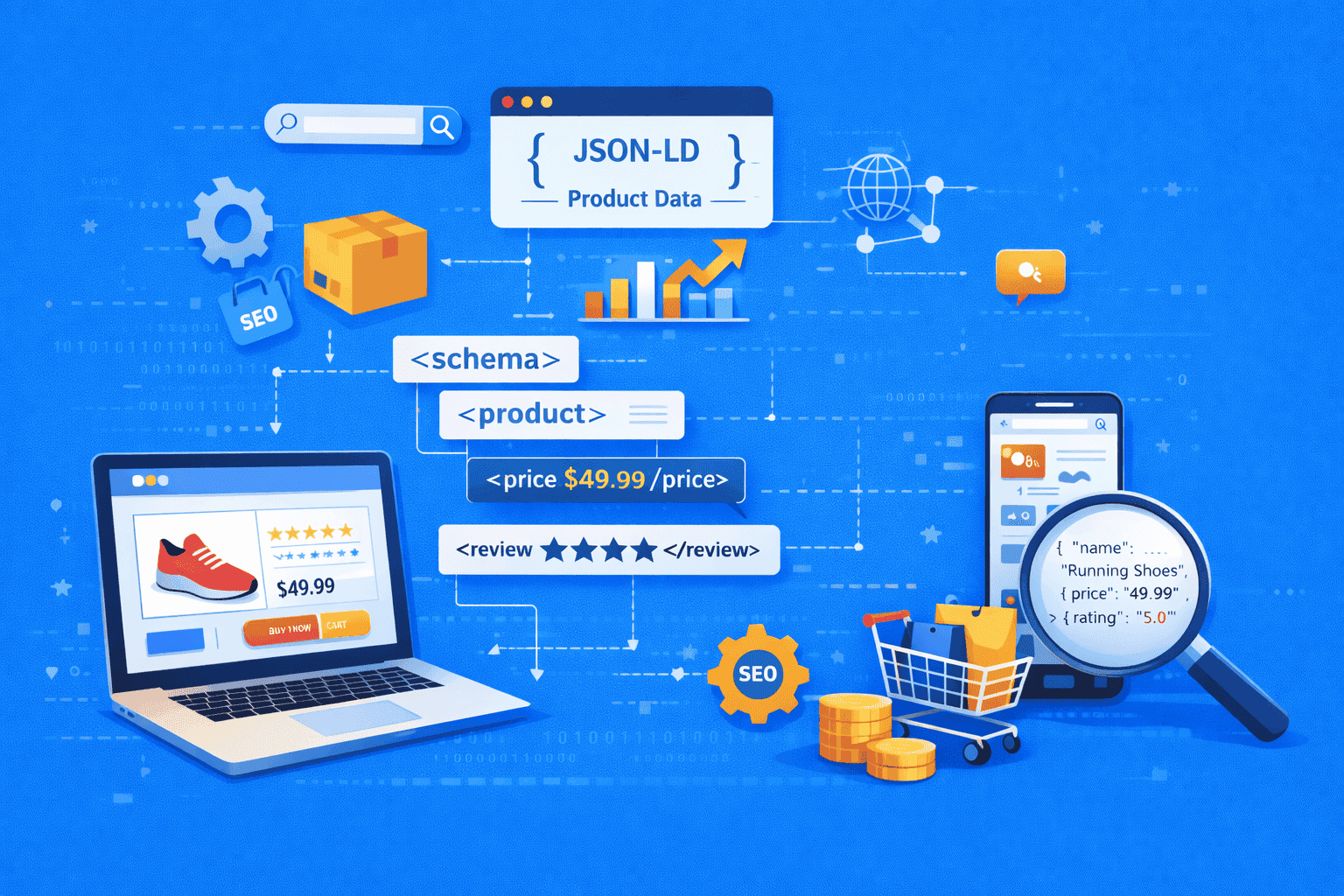
Schema markup is how you speak directly to machines. Product, Offer, Review, and FAQ schema give AI systems a structured, machine-readable layer of your page that confirms the facts they are about to repeat in a recommendation. Google's AI Mode, Bing's LLMs, and third-party AI tools have all confirmed that correctly implemented schema directly supports their ability to understand and surface products.

The most common schema failure in ecommerce is a data mismatch: your JSON-LD reports a price that does not match what is displayed on the page, or variant details in the schema do not reflect current inventory. When AI systems detect these inconsistencies, they default to not citing you. Every field you mark up must exactly mirror what a user sees. Audit your schema implementation at the same cadence as your pricing updates.
6. Crawl Budget Precision: Ensuring Your Best Pages Are Seen First
Crawl budget is the finite amount of attention search and AI crawlers allocate to your site. Every crawler request spent on a duplicate filter URL, an expired product page, or a low-value pagination variant is one not spent on a high-converting PDP.
For large ecommerce catalogs, crawl budget discipline is one of the most direct levers for improving keyword impressions. Block low-value pages from crawl via robots.txt. Consolidate near-duplicate content. Fix internal linking depth so your highest-priority product pages are discoverable early in a crawl sequence, not buried five clicks deep. Submit only indexable, high-value URLs to your XML sitemap.
The payoff is that when crawlers do reach your best pages faster and more frequently those pages accumulate indexing signals and visibility faster than competitors who are still wasting budget on thin catalog noise.
What AI Looks for by Ecommerce Category
Beyond the universal elements above, AI systems like ChatGPT and Google AI Overviews apply category-specific judgment when evaluating product pages. The list below summarizes the content signals that most strongly influence AI recommendations by vertical:

- Fashion - Fit guidance, sizing charts, material composition, aggregated customer fit feedback, sustainability certifications
- Health & Wellness - Full ingredient lists, dosage instructions, contraindications, sourcing transparency, third-party clinical certifications
- Electronics - Complete technical specs, compatibility information, comparative benchmarks, safety and efficiency certifications
- Home & Furniture - Exact dimensions, room size guidance, assembly complexity, material and care details, configuration options
- Outdoor & Sports - Weather and performance ratings, weight and capacity specs, use-case scenarios, safety certifications
- Baby & Kids - Age and weight suitability ranges, safety certifications (OEKO-TEX, GREENGUARD), material transparency, ergonomic or developmental benefits
The common thread across every category is specificity. Vague product pages that could describe any product in a category do not give AI enough precision to match against specific user queries. The more granular and situational your product content, the more surface area you create for AI to find you and cite you.
Scaling This Across Thousands of SKUs: Where N7 SERA-GPT Comes In
Reading this checklist is straightforward. Executing it across a catalog of 10,000 or 100,000 products while managing seasonal inventory changes, regional pricing variations, and a live production environment is an entirely different challenge.
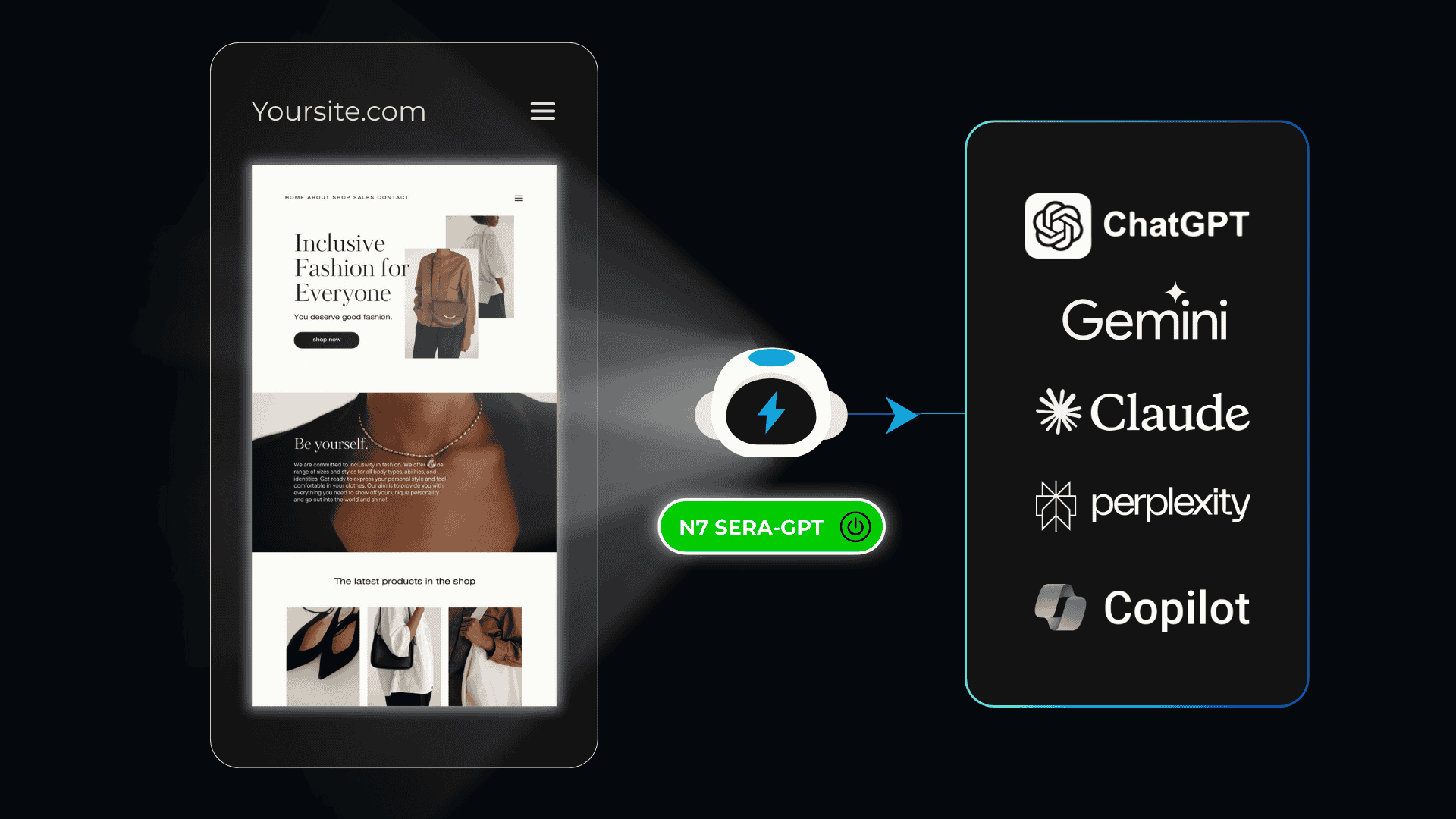
N7 SERA-GPT was built specifically for this execution gap. The product creates an AI-optimized mirror of your ecommerce site a parallel version built in static, crawler-readable HTML, with schema markup already applied, product feeds synchronized in real time, and crawl logic engineered to prioritize your highest-value pages. Neither your engineering team nor your production site are disrupted in the process.
Ecommerce brands using N7 SERA-GPT see 5–20x faster crawl rates on priority product pages and a significant lift in keyword impressions, driven entirely by giving Google and GPT crawlers cleaner, faster, more complete access to the product content they already have.
The Brands That Act Now Will Own the Visibility Others Are About to Lose
AI-driven product discovery is not an emerging channel to monitor. It is the primary shift in how purchase decisions are being seeded in 2026. The consumer has moved. The question is whether your product pages and the infrastructure serving them have moved too.
The good news is that the fundamentals have been already relevant for traditional SEO. Use-case-driven copy. Clean, consistent schema. Real-time feeds. Strong review signals. Third-party validation. These are achievable for any ecommerce team. What separates the brands that execute from those that stall is usually not strategy - it is the scale and speed of implementation.