How to Optimize Your Ecommerce Product Pages for ChatGPT?
.png)
In This Article
- How ChatGPT Actually Evaluates Product Pages
- The Technical Problem Most Ecommerce Teams Haven't Diagnosed
- 6 Product Page Elements That Drive ChatGPT Visibility
- 1. Product Descriptions Built Around Use Cases, Not Features
- 2. Real-Time Pricing and Inventory Signals
- 3. Reviews That Reveal Patterns, Not Just Ratings
- 4. Awards, Certifications, and Third-Party Validation
- 5. Structured Data That Matches Every Visible Element
- 6. Crawl Budget Precision: Make Sure Your Best Pages Are Seen First
- What ChatGPT Looks For — by Ecommerce Category
- Scaling This Across Thousands of SKUs: Where N7 SERA-GPT Comes In
- The Brands That Act Now Will Own the Visibility Others Are About to Lose
The Discovery Layer Has Already Moved - Has Your Product Page?
A meaningful share of shoppers no longer begin a purchase by typing a keyword into Google. They open ChatGPT and ask a full sentence: "What's the best standing desk for a small home office?" or "Which protein powder has the cleanest ingredients?" Within seconds, they get a confident, named recommendation.
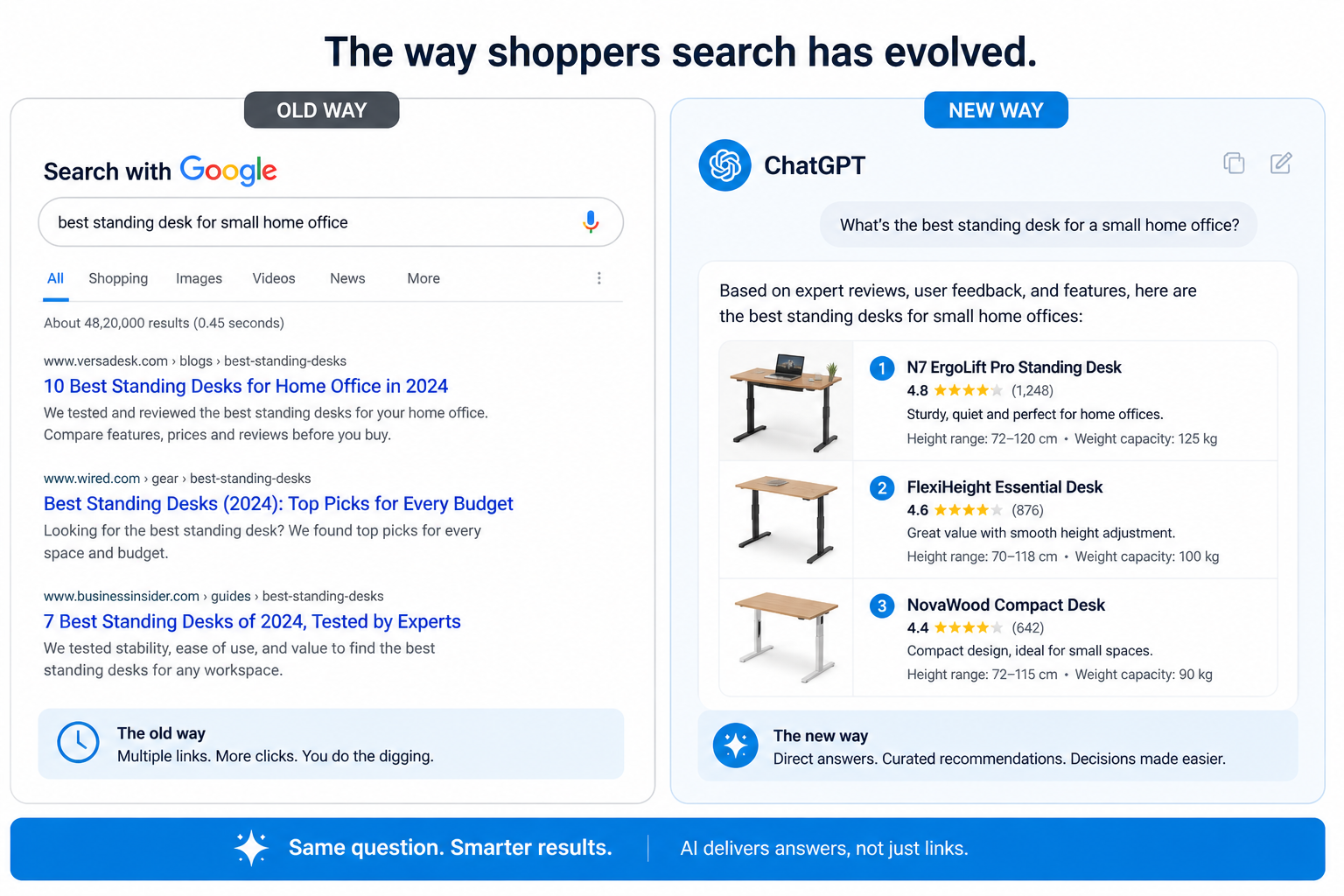
For ecommerce marketers, this isn't a future-state problem. Research indicates that more than half of shoppers now turn to generative AI tools at some point in the purchase process, and the number is accelerating. AI-powered discovery is already reshaping which products get seen, considered, and bought - and the brands winning in this environment share one common thread: their product pages are built for machines as much as they are for people.
This is exactly the gap N7 SERA-GPT was built to close. Before we get to the solution, let's break down how ChatGPT actually evaluates product pages, what signals drive recommendations, and the infrastructure changes separating the brands gaining AI visibility from those silently losing it.
How ChatGPT Actually Evaluates Product Pages
Unlike Google, which has historically ranked pages based on link authority and keyword density, AI systems like ChatGPT, Claude, Google AI Overviews, and Perplexity evaluate product pages through two primary lenses: consistency and consensus.
Consistency means the information AI finds about your product - price, availability, specifications, use cases - matches across your website, your product feeds, and third-party sources. When signals conflict, AI systems treat your content as unreliable and move on to a competitor they can cite with confidence.
Consensus means multiple independent sources validate what your product is, what it does, and who it's best for. This includes customer reviews on your own site, editorial coverage, ratings on retail platforms, and third-party test results. The more aligned these external signals are, the more confidently an AI will recommend you.
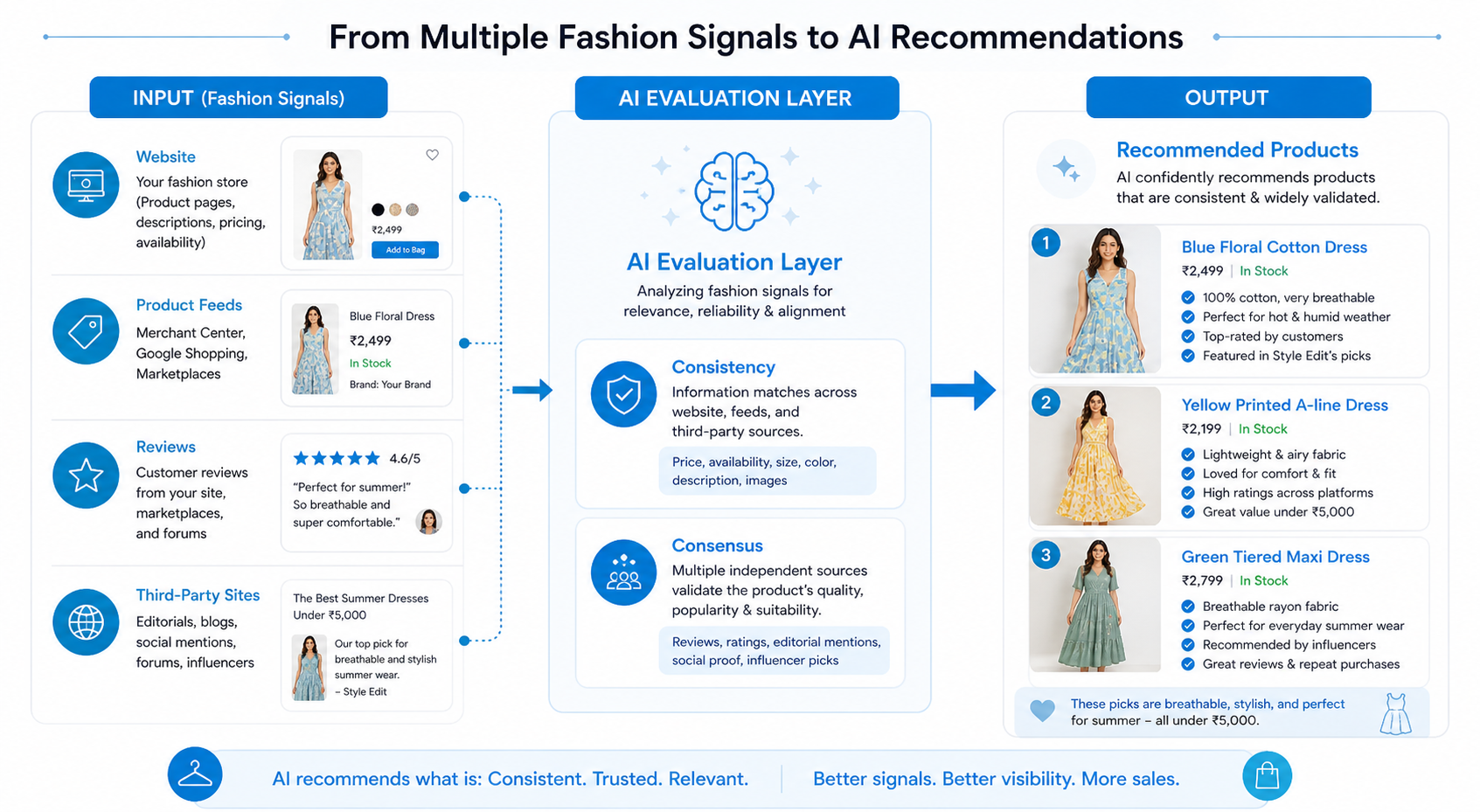
These two filters explain something ecommerce marketers often find puzzling: why a technically inferior competitor with less traffic sometimes surfaces in ChatGPT responses ahead of a dominant brand. The answer is usually that their product information is cleaner, more consistent, and better validated across the web.
Key Insight: AI does not just crawl your pages - it cross-references them. Inconsistency between your site, feeds, and third-party sources is the fastest way to disappear from ChatGPT recommendations.
ChatGPT's recommendation logic also relies heavily on a few external pillars: industry-rankings and "best of" lists, expert reviews, customer reviews on platforms like G2 and Reddit, third-party usage data, and overall social sentiment across forums like Quora and Substack. Companies whose products win awards or earn accreditations from authoritative organizations are more likely to be recommended in ChatGPT search results.
The Technical Problem Most Ecommerce Teams Haven't Diagnosed
Before any of the content-level optimization matters, your pages need to actually be readable by the systems doing the evaluating. For many ecommerce sites, they are not - at least not fully.
AI crawlers, including GPTBot (OpenAI's crawler) and OAI-SearchBot, do not execute JavaScript. They retrieve raw HTML and process whatever is present at that moment. For sites built on client-side rendering frameworks - where product titles, prices, and availability are assembled in the browser after a JavaScript event - the AI receives an empty shell. Your product effectively does not exist in the response it reads.
JavaScript-heavy pages can take up to nine times longer to crawl than static HTML equivalents. Multiplied across a catalog of tens of thousands of SKUs, the compounding effect on crawl budget is enormous. Both Googlebot and GPTBot end up spending their limited attention on the scaffolding of your site rather than the products inside it.
Between May 2024 and May 2025, AI crawler traffic across the web grew by 96%. GPTBot alone went from 5% of AI crawler share to 30%. These systems are actively indexing ecommerce at scale - but only what they can read.
The Math: If your product content loads via JavaScript, there's a high chance AI crawlers see nothing. No schema, no description, no price. Your page is indexed as if it were blank.
The first technical step is also the simplest: confirm that your robots.txt allows GPTBot and OAI-SearchBot. If those crawlers are blocked, your products are invisible to ChatGPT regardless of how well-written your descriptions are.
6 Product Page Elements That Drive ChatGPT Visibility
Assuming your pages are technically accessible, these are the content and structural elements that determine whether ChatGPT recommends your products or ignores them.
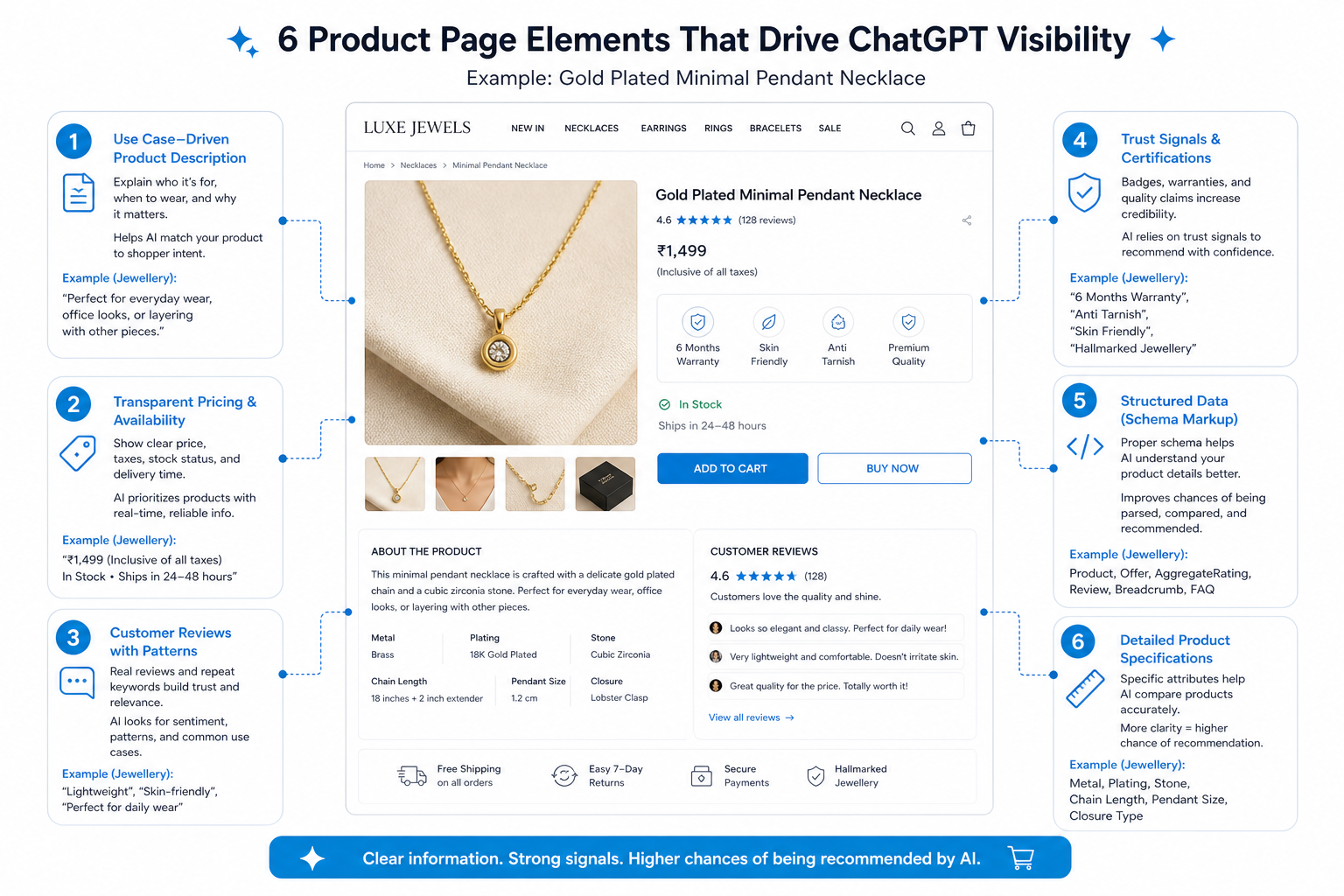
1. Product Descriptions Built Around Use Cases, Not Features
ChatGPT search is fundamentally intent-driven. When a shopper asks ChatGPT for "comfortable shoes for standing all day, under Rs 10,000, breathable," the system isn't scanning for the phrase "shoes." It's semantically matching your product copy to every element of that query - activity, conditions, constraints, and outcome.
Product descriptions that lead with what a product is used for and who uses it consistently outperform descriptions that lead with technical specifications. The goal is to embed your product clearly within the situations where it becomes the answer. AI assistants don't match products to keywords - they match products to people and their unique needs.
A standing desk could be ideal for remote workers, people with back pain, gamers, or small business owners outfitting a home office. If a product page only speaks to one of these audiences, it might not get recommended to the others in AI search. A single, well-defined use case on a PDP does more for ChatGPT visibility than a generic feature list that could apply to any product in the category.
Practical approach: Map your top-selling products to the most common customer scenarios that triggered the purchase. Interview recent buyers. Mine review data. What specific problem were they solving, and how do they describe it? That language belongs in your product copy.
2. Real-Time Pricing and Inventory Signals
AI shopping assistants in ChatGPT, Google AI Mode, and Perplexity are now filtering product recommendations by price range, availability, and discount status in real time. If your data is stale - or if your page price and your merchant feed price don't agree - you fall out of those filtered results entirely.
The brands that surface consistently in AI price-filtered queries are those with live product feed connections to Google Merchant Center and, where applicable, first-party data partnerships with AI platforms directly. With OpenAI's Agentic Commerce Protocol (ACP) and the new ChatGPT Product Feed Specification, merchants can now submit structured product data to ChatGPT that enables ChatGPT to ingest structured catalog data, understand merchant inventory, and surface relevant products in context.
Sale pricing deserves particular attention: AI systems actively identify and surface discounted products when budgets are part of the query, but only when the original and sale price are both clearly presented and consistent across page and feed.
Treating your product feed as a core SEO asset - not just an advertising operations task - is one of the highest-ROI shifts an ecommerce marketer can drive in 2026.
3. Reviews That Reveal Patterns, Not Just Ratings
ChatGPT does not just display star ratings - it analyzes review content to understand what a product actually does in real-world use. Repeated mentions of specific use cases, materials, or benefits across a review set create a signal the AI can synthesize and restate in its recommendations.
A product with 4.7 stars and 600 reviews mentioning "sensitive skin" will surface for sensitive-skin queries even if the product description itself does not emphasize it. The crowd-sourced use case data functions as additional training signal for the AI. This is why actively managing the quality and specificity of your review program - not just the volume - is a strategic priority.
Tactical tip: Prompt customers for situational context in review forms. Ask what they were trying to solve, not just whether they liked the product. That specificity is what AI reads and reuses. And remember to implement AggregateRating schema with ratingValue, reviewCount, and bestRating fields so the signal is machine-readable.
4. Awards, Certifications, and Third-Party Validation
AI systems are designed to minimize the risk of recommending something that turns out to be wrong. Third-party validation - industry awards, safety certifications, editorial recognition, clinical test results - gives ChatGPT the external consensus signals it needs to cite your product with confidence.
Analysis of ecommerce brands tracked against AI visibility benchmarks shows a strong correlation: brands with above-average AI visibility rates consistently feature third-party recognition prominently on their product pages. Certifications function as trust anchors that both AI systems and consumers respond to.
If your brand has earned recognition - best-in-class awards, safety certifications, sustainability badges, media endorsements — these belong on the PDP itself, not buried in a brand-story page that ChatGPT may never connect to the individual product.
5. Structured Data That Matches Every Visible Element
Schema markup is how you speak directly to machines. Product, Offer, Review, AggregateRating, and FAQ schema give AI systems a structured, machine-readable layer of your page that confirms the facts they are about to repeat in a recommendation. Google's AI Mode, Bing's LLMs, and third-party AI tools have all confirmed that correctly implemented schema directly supports their ability to understand and surface products.
The most common schema failure in ecommerce is a data mismatch: your JSON-LD reports a price that does not match what is displayed on the page, or variant details in the schema do not reflect current inventory. When AI systems detect these inconsistencies, they default to not citing you. Every field you mark up must exactly mirror what a user sees.
According to industry analysis, only a small fraction of ecommerce product pages have complete schema markup — making this one of the highest-leverage gaps to close. A 30-minute competitive audit comparing your schema against competitors who already appear in ChatGPT often reveals two or three missing fields that can move you from invisible to visible within days.
6. Crawl Budget Precision: Make Sure Your Best Pages Are Seen First
Crawl budget is the finite amount of attention search and AI crawlers allocate to your site. Every crawler request spent on a duplicate filter URL, an expired product page, or a low-value pagination variant is one not spent on a high-converting PDP.
For large ecommerce catalogs, crawl budget discipline is one of the most direct levers for improving keyword impressions in both Google and ChatGPT. Block low-value pages from crawl via robots.txt. Consolidate near-duplicate content. Fix internal linking depth so your highest-priority product pages are discoverable early in a crawl sequence — not buried five clicks deep. Submit only indexable, high-value URLs to your XML sitemap.
When crawlers reach your best pages faster and more frequently, those pages accumulate indexing signals and visibility faster than competitors who are still wasting budget on thin catalog noise.
What ChatGPT Looks For — by Ecommerce Category
Beyond the universal elements above, AI systems apply category-specific judgment when evaluating product pages. The signals that most strongly influence ChatGPT recommendations vary by vertical:
- Fashion — Fit guidance, sizing charts, material composition, aggregated customer fit feedback, sustainability certifications.
- Health & Wellness — Full ingredient lists, dosage instructions, contraindications, sourcing transparency, third-party clinical certifications.
- Electronics — Complete technical specs, compatibility information, comparative benchmarks, safety and efficiency certifications.
- Home & Furniture — Exact dimensions, room-size guidance, assembly complexity, material and care details, configuration options.
- Outdoor & Sports — Weather and performance ratings, weight and capacity specs, use-case scenarios, safety certifications.
- Baby & Kids — Age and weight suitability ranges, safety certifications, material transparency, ergonomic or developmental benefits.
The common thread across every category is specificity. Vague product pages that could describe any product in a category do not give AI enough precision to match against specific user queries. The more granular and situational your product content, the more surface area you create for ChatGPT to find you and cite you.
Scaling This Across Thousands of SKUs: Where N7 SERA-GPT Comes In
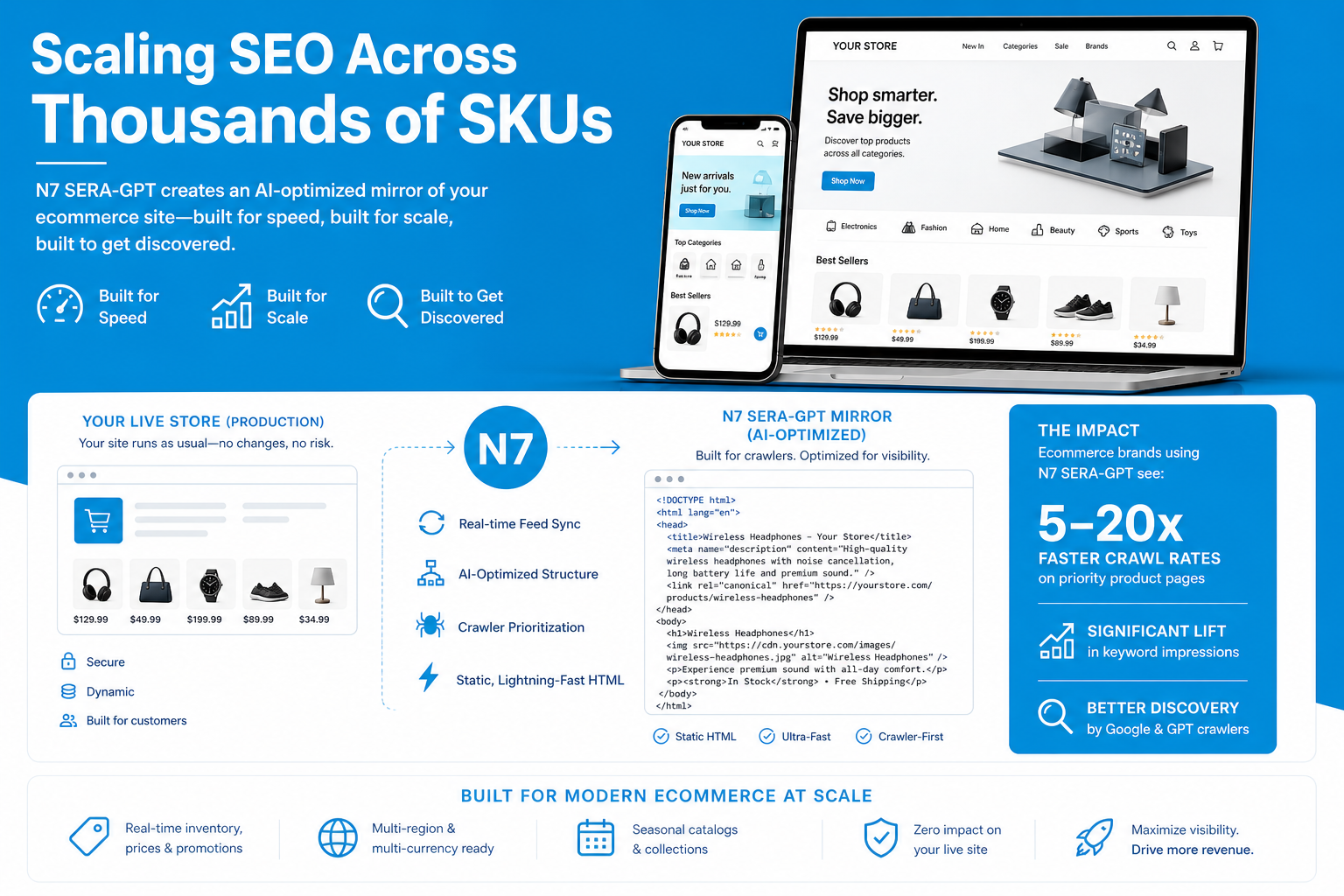
Reading this checklist is straightforward. Executing it across a catalog of 10,000 or 100,000 products — while managing seasonal inventory changes, regional pricing variations, and a live production environment — is an entirely different challenge. This is the execution gap that stalls most ecommerce teams.
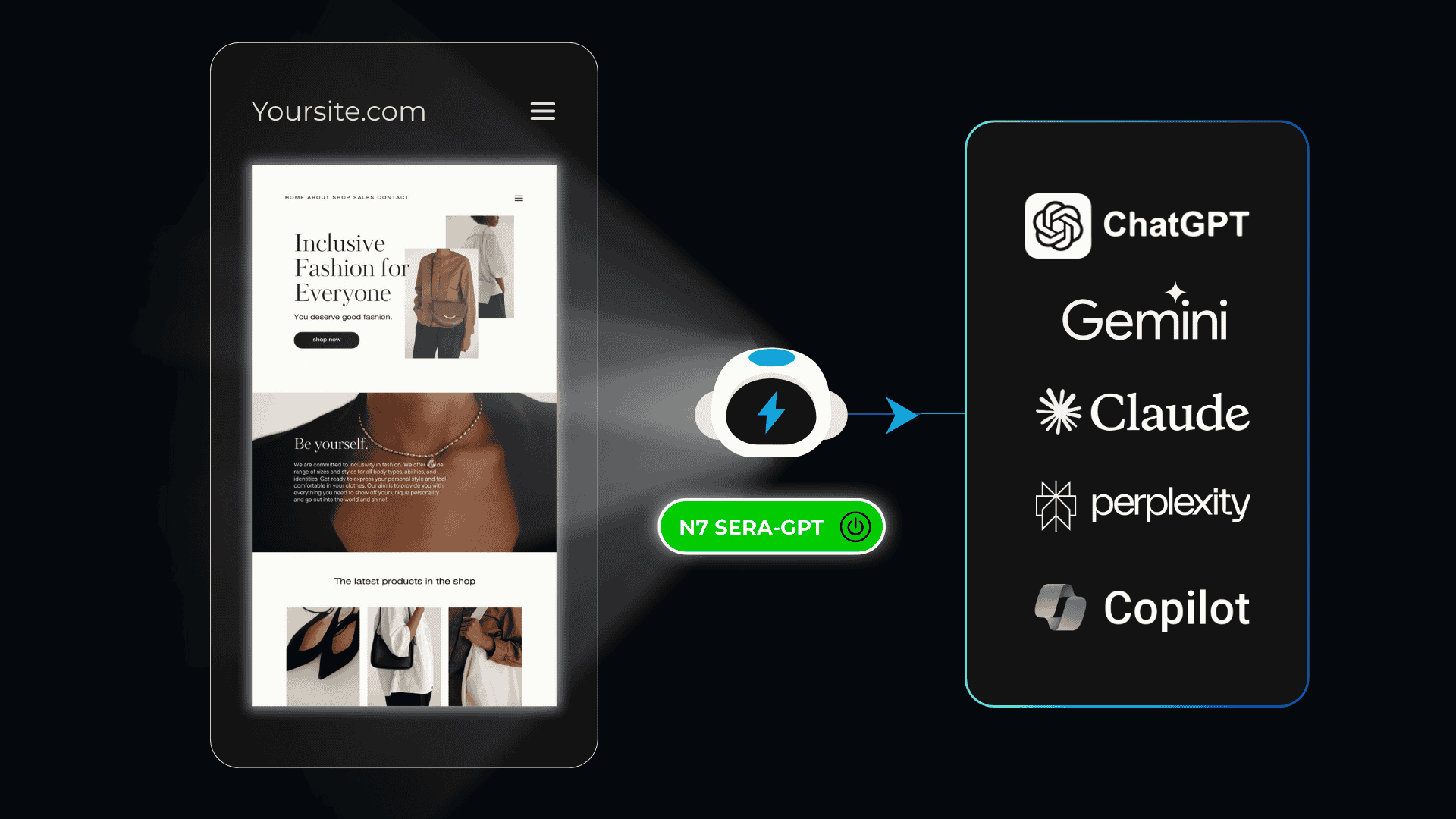
N7 SERA-GPT (Search Engine Rank Accelerator – GPT) was built specifically for this gap. The product creates an AI-optimized mirror of your ecommerce site — a parallel version built in static, crawler-readable HTML, product feeds synchronized in real time, and crawl logic engineered to prioritize your highest-value pages. Neither your engineering team nor your production site is disrupted in the process.
Ecommerce brands using N7 SERA-GPT see 5–20x faster crawl rates on priority product pages and a significant lift in keyword impressions, driven entirely by giving Google and GPT crawlers cleaner, faster, more complete access to the product content they already have.
The Brands That Act Now Will Own the Visibility Others Are About to Lose
AI-driven product discovery is not an emerging channel to monitor. It is the primary shift in how purchase decisions are being seeded in 2026. The consumer has moved. The question is whether your product pages — and the infrastructure serving them — have moved too.
The good news is that the fundamentals overlap heavily with traditional SEO: use-case-driven copy, clean and consistent schema, real-time feeds, strong review signals, third-party validation. These are achievable for any ecommerce team. What separates the brands that execute from the ones that stall is usually not strategy — it's the scale and speed of implementation.
If you want your product pages cited, recommended, and purchased inside ChatGPT, you need infrastructure that can deliver clean, consistent, machine-readable content at the speed AI crawlers now operate. N7 SERA-GPT is that infrastructure.
Ready to get recommended by ChatGPT?
Explore N7 SERA-GPT - and start your free AI-driven recommendation boost today.
FAQs
How do I make my product pages visible to ChatGPT?
Allow OAI-SearchBot and GPTBot in your robots.txt, serve product content in static, server-rendered HTML (not client-side JavaScript), implement complete Product, Offer, and AggregateRating schema, keep your pricing and inventory feeds synced in real time, and write product copy around use cases rather than features.
Does ChatGPT use Google to recommend products?
Yes — ChatGPT's recommendations are heavily influenced by Google's top-ranked search results, Google Merchant Center feeds, and authoritative third-party lists and review platforms. A healthy Merchant Center account directly affects your ChatGPT visibility, even though it has historically been treated as an advertising tool.
What schema do I need for ChatGPT product page optimization?
At minimum: Product, Offer, AggregateRating, Review, and FAQ schema implemented as JSON-LD. Every field must exactly match what a user sees on the page; mismatches between schema and visible content cause ChatGPT to default to not citing you.
Why are AI crawlers seeing my product pages as blank?
Most likely because your product details (title, price, availability) are rendered client-side via JavaScript. GPTBot and OAI-SearchBot do not execute JavaScript — they read raw HTML. JavaScript-heavy pages can also take up to nine times longer to crawl than static HTML. The fix is server-side rendering or an AI-optimized static mirror like N7 SERA-GPT.
How does N7 SERA-GPT help with ChatGPT optimization?
N7 SERA-GPT creates an AI-optimized mirror of your ecommerce site in static, crawler-readable HTML, with schema markup, real-time feed synchronization, and crawl prioritization built in — delivering 5–20x faster crawl rates and a measurable lift in keyword impressions, without any code changes to your production site.